

2x Divided By X Squared
Long Polynomial Partitioning
Unlike the examples on the previous page, nearly all polynomial divisions do not "come out fifty-fifty"; usually, you'll end upwardly with a remainder.
-
Divide 3x 3 − fivex 2 + 10x − three by 3x + one
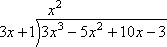
I start with the long-segmentation fix-up:

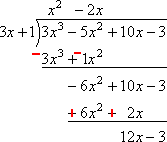
Looking merely at the leading terms, I split 310 3 by 3x to get 10 2 . This is what I put on peak:
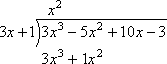
I multiply this x ii by the threex + one to get 3x three + 1ten 2 , which I put underneath:
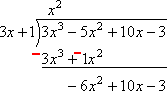
Then I change the signs, add down, and think to bear downward the "+10x − 3" from the original dividend, giving me a new bottom line of −sixten 2 + tenx − three:
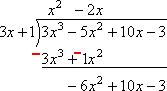
Dividing the new leading term, −610 2 , by the divisor's leading term, 3x , I become −2x , so I put this on top:
Then I multiply −2x by 3x + one to get −6x two − 210 , which I put underneath. I change signs, add down, and remember to conduct downwards the "−3 from the dividend:
My new last line is "12x − iii. Dividing the new leading term of 12x by the divisor's leading term of 3x , I get +4, which I put on top. I multiply 4 by 3ten + 1 to go 12x + 4. I switch signs and add down. I stop upwardly with a residual of −vii:
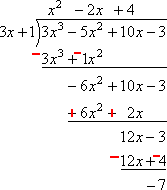
This division did non come out fifty-fifty. What am I supposed to do with the balance?
Think dorsum to when y'all did long division with plain numbers. Sometimes at that place would be a remainder; for instance, if you divide 132 by 5:
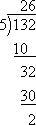
...in that location is a balance of 2. Recollect how y'all handled that? You lot made a fraction, putting the remainder on top of the divisor, and wrote the respond as "twenty-six and two-fifths":
The kickoff class, without the "plus" in the middle, is how "mixed numbers" are written, but the meaning of the mixed number is actually the form with the addition.
We do the same thing with polynomial sectionalization. Since the remainder in this instance is −7 and since the divisor is threex + 1, so I'll plough the remainder into a fraction (the remainder divided by the original divisor), and add this fraction to the polynomial across the height of the division symbol. Then my answer is this:
Alert: Do not write the polynomial "mixed number" in the same format as numerical mixed numbers! If you lot but suspend the partial part to the polynomial role, this will exist interpreted as polynomial multiplication, which is not what you mean!
Note: Different books format the long division differently. When writing the expressions across the superlative of the division, some books will put the terms in a higher place the same-caste term, rather than above the term being worked on. In such a text, the long division above would exist presented as shown here:
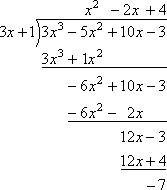
The only difference is that the terms across the top are shifted to the right. Otherwise, everything is exactly the same; in particular, all the computations are exactly the aforementioned. If in doubt, use the formatting that your instructor uses.
You may be wondering how I knew to stop when I got to the −7 remainder. It's much similar how y'all knew when to stop when doing the long division (before y'all learned about decimal places). In one case you got to something that the divisor was likewise large to divide into, y'all'd gone as far as y'all could, and so you lot stopped; whatsoever else was left, if anything, was your remainder. The same goes for polynomial long division. The −7 is merely a constant term; the iiix is "besides large" to get into it, only similar the 5 was "too big" to get into the 2 in the numerical long sectionalization example above. Once yous go to a remainder that's "smaller" (in polynomial degree) than the divisor, yous're washed.
-
Divide 2x iii − 9ten ii + fifteen by 2x − 5
Kickoff off, I notation that there is a gap in the degrees of the terms of the dividend: the polynomial twox iii − 9x ii + 15 has no x term. My piece of work might become complicated within the partition symbol, so information technology is important that I make sure to leave space for a x -term column, just in case. (This is like a nothing in, say, the hundreds place of the dividend holding that column open for subtractions under the long-division symbol.) I can create this space by turning the dividend into two10 3 − 9x two + 0x + xv.
(This is a legitimate mathematical step. I've only added goose egg, and so I oasis't actually changed the value of annihilation.)
At present that I accept all the "room" I might need for my piece of work, I'll practice the partitioning. I starting time, equally usual, with the long-division set-up:

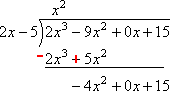
Dividing 2x iii by 2ten , I become ten 2 , then I put that on peak. And then I multiply the 10 2 by the twox − 5 to become 2x three − 5ten 2 , which I put underneath. Then I change the signs, add downwardly, and deport down the 010 + 15 from the original dividend. This gives me −ivx 2 + 010 + 15 equally my new bottom line:
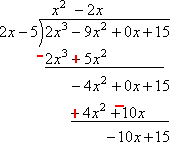
Dividing −4x two by 2x , I become −iix , which I put on top. Multiplying this −ii10 by 210 − 5, I get −ivx ii + xten , which I put underneath. And then I alter the signs, add downwardly, and comport down the +15 from the previous dividend. This gives me −10x + 15 as my new bottom line:
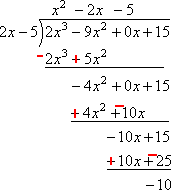
Dividing −10x by 2x , I get −5, which I put on elevation. Multiplying −five by 2x − 5, I get 10x + 25, which I put underneath. So I change the signs and add together down, which leaves me with a residual of −10:
I need to recollect to add together the remainder to the polynomial part of the respond:
-
Divide 4x 4 + i + 3x three + iix by x ii +x + 2
Outset, I'll rearrange the dividend, so the terms are written in the usual club:
4x iv + 3x 3 + 2x + 1
I discover that there'southward no x 2 term in the dividend, so I'll create one by calculation a 0x two term to the dividend (inside the division symbol) to make infinite for my piece of work.

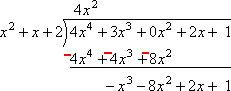
Then I'll do the segmentation in the usual manner. Dividing the fourten 4 by 10 two , I get 4x 2 , which I put on top. Then I multiply through, and then forth, leading to a new bottom line:
Dividing −x three by x 2 , I get −x , which I put on peak. And then I multiply through, etc, etc:
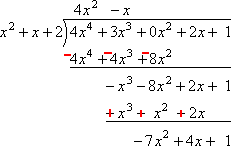
Dividing −viix 2 by x 2 , I become −7, which I put on top. Then I multiply through, etc, etc:
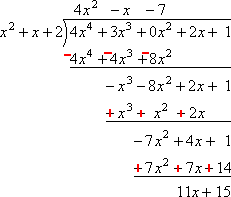
Then I'chiliad washed dividing, because the remainder is linear (1110 + 15) while the divisor is quadratic. The quadratic can't carve up into the linear polynomial, so I've gone equally far as I tin can.
And then my answer is:
To succeed with polyomial long division, you need to write neatly, recall to change your signs when you lot're subtracting, and work carefully, keeping your columns lined up properly. If y'all do this, and so these exercises should non be very hard; annoying, peradventure, just not hard.

2x Divided By X Squared,
Source: https://www.purplemath.com/modules/polydiv3.htm
Posted by: browningmayes1978.blogspot.com
0 Response to "2x Divided By X Squared"
Post a Comment